Tuesday, September 7, 2010

S2- RETAIL


RETAIL ADVERTISING
COLES


When the GFC hit- marketers seemed to be the employees that suffered. After a while, companies began to realise the importance of marketing to distinguish its brand in such tough economic times. The marketing and advertising after the global financial crisis focused on value added products or services. Coles also adopted this strategy by employing a well-known Australian chef to endorse its products and create value. It began with recipe catalogues, which consumers were free to take home. These catalogues created recipes, which advertised Coles products and low prices.  Then Coles took that one step further and employed Curtis Stone- celebrity chef. Curtis enhanced the Coles image and created recipes to feed 4 people for $10 or less. This was a great strategy to leverage the brand name and association. 


Advertisement: Coles
Source: 
www.markettomouth.blogspot.com


Advertisement: Coles
Source: www.breadmilkeggs.com.au


S2 - BUSINESS TO BUSINESS

ADVERTISEMENT: BLOOMTOOLS - business website design
SOURCED FROM:  www.bloomtools.com.au
SOURCED ON:  September 1st 2010


Bloomtools are in the business of developing websites, for businesses and individuals. After researching business to business advertising, it is evident that the aim of the advertising is to educate consumers about the product or service. A lot of the business advertising is fairly basic and straight to the point. Leaving little room for creativity. Bloomtools have utilised their brand name to leverage creativity in web design. Creativity stems from imagination and Bloomtools have captured this in the $ tool symbol. Although this advertisement gets to the point- there is room for creativity.


ADVERTISEMENT: NAB - business fees
SOURCED FROM: www.nab.com.au
SOURCED ON: August 30th 2010


At a time when bank fees and overdrawn fees are at the forefront of the news, NAB quickly revealed an advertisement stating 'we've abolished more bank fees.' This advertisement applies to business bank fees. It was a smart move to advertise this point, however once again NAB got straight to the point without utilising a creative style.
WESTPAC on the other hand, have introduced business specialists. WESTPAC advertised these employees via TVC, and made it seem as though the employees were part of the brochure. Small touches like these can make a big impact connecting with the audience.
Trade press
Source: http://www.smh.com.au/business/fee-gouging-banks-face-huge-class-action-20100512-uw8h.html


JOURNAL ARTICLE:
SOURCE:
Stephanie Brookes, Oliver Chesher


B2B marketing: an undervalued sector?


ADMAP MAGAZINE
Issue 483, May 2007.
Sourced from www.warc.com/admap


Admap Magazine

May 2007, Issue 483

www.warc.com/admap


B2B marketing: an undervalued sector?


Business-to-business marketing agency Cicero has conducted and released a significant new study into the world of B2B marketing.
This major piece of market research, carried out in conjunction with industry publication B2B Marketing and research company Ci Research, gathered detailed data directly from senior practitioners in the field of B2B during 2006.
Cicero managing director Danny Turn-bull says, 'This is almost certainly the first, and definitely the most in-depth, study of its kind ever to probe into the UK B2B landscape, which our data show is an industry turning over just under £10 billion a year.
'It is long overdue, as B2B marketers have been keen for many years to demonstrate that we are a viable and distinct audience, and cannot simply be dismissed as an adjunct to the higher-profile consumer marketing sector.'
The report, which is now on sale, should prove invaluable to B2B marketers themselves as they seek to make sense of the various challenges confronting them in their daily roles, and to the service sector of agencies and suppliers, seeking to meet the needs and objectives of this audience.
According to Turnbull, the report makes for disquieting reading in places, as it shows marketing to be undervalued in British businesses, with 37% of respondents stating that marketing was seen as a cost rather than a value contributor within their business. This is very much at odds with the often-espoused view that marketing should be at the heart of every organisation.
But armed with the new knowledge gleaned from this research, the industry will be better equipped to meet the challenge of balancing the need for short-term, easy-to-measure response with a more holistic approach to building business brands and to put marketing where it belongs, at the heart of organisation strategy.
OBJECTIVES
We had established that one of the main problems of the sector was the low level of understanding and visibility in the wider marketing world. This was hindered by a lack of meaningful, thorough and reliable insight. Therefore, the research set out to address this by producing the first comprehensive analysis of the UK B2B marketing industry, the practitioners within it and how it is evolving.
The objective was to help raise the profile of the industry by facilitating greater understanding of its size, scope and the issues that are shaping it, and to further shape and define the B2B community. We aimed to provide a reliable document that practitioners from all areas of the B2B sector could use as a touchstone to help contextualise their activities, learn from trends in the wider community, and ultimately drive more success in their marketing.
WHAT DID WE WANT TO KNOW?
There were a number of questions that we wanted to answer through this research.


  1. How big is the B2B marketing sector? How many people does it encompass, and how much money do they spend?


  2. Who are B2B marketers? What are their backgrounds and how has this influenced their thinking about the future?


  3. What are the current trends in B2B marketing? Which media are being used for which purposes?


  4. How are they investing their budgets and selecting service providers?


  5. How is the B2B marketing sector likely to evolve?
In order to get an accurate picture of the B2B marketing space, we felt it was important that we spoke only to marketing decision-makers: in other words marketing managers or above, but marketing directors wherever possible.
METHODOLOGY
Participants were recruited during September 2006 via a telemarketing campaign to a database of B2B marketers, who were promised their choice of voucher (from a limited selection) in return for completing an online questionnaire. In all 147 people completed the questionnaire, from a wide range of different companies, in different industry sectors.
SIZE AND SCOPE OF THE MARKET
The research produced a number of key insights into the B2B marketing sector. The first among these was the most accurate indication yet of its size and scale, both in terms of amount of annual spend and number of practitioners:


  • Estimated expenditure on B2B marketing communications during 2005: £9.8 billion.


  • Estimated number of practitioners with marketing in their job title focusing purely on the B2B sector: 176,000.


  • Estimated number of practitioners with marketing in their job title for whom B2B is at least part of their remit (along with B2C): 272,000.
(For more information on how these figures were obtained, see the main report.)
These figures confirm that the B2B sector is a significant audience in its own right, and that it should not be seen as simply a subdivision of the overall marketing community. The 'poor relation' tag must be recognised as unwarranted, and should be discarded.
KEY FINDINGS
The research also identified some important trends, issues and concerns underlying the B2B marketing sector, which will all have considerable impact on its future development.


  1. B2B is a booming market: 93% of respondents described themselves as 'very' or 'fairly' confident about the future economic climate for their organisation. Meanwhile, 90% expected their marketing budget to increase or remain constant in the next two years, and 56% had seen it increase in the previous two years.


  2. Beyond a website and basic email marketing, use of digital marketing techniques is limited. Only 52% of companies are currently investing in search marketing, less than 10% have used viral and 5% podcasts or webinars. Despite the hype, actual exposure to and through these channels is very limited, and it is likely that companies are missing opportunities.


  3. Email will be the single biggest growth channel in B2B. This is despite warnings regarding spam, inbox overload and general erosion of response rates; 49% of respondents said they were expecting to invest more money in email during this period, against the next most popular medium, direct mail, on 33%. 'Awareness raising' is seen as the primary objective for emarketing.


  4. Agencies are not being fully utilised. Over a quarter of B2B practitioners do not currently use any agencies for their marketing, yet 40% use three or more. Only 20% of agencies are used in a strategic capacity.


  5. B2B marketing lacks formal entry regulation. Only around 50% of B2B marketers have any form of marketing qualification. Three-quarters of respondents believe that existing courses are biased towards B2C activity, while over half of companies have no budget for training. Only 30% plan to undertake any further marketing-related studies.


  6. There is a recruitment problem in B2B marketing. Experienced B2B marketers are difficult to recruit, according to the overwhelming majority of practitioners who have experience of doing so. Only 40% of B2B marketers followed a marketing career path; the majority transferred from other professions.


  7. Trade bodies are not representing B2B marketers. Less than half of practitioners interviewed are members of any of the marketing trade bodies.


  8. Brand-building activity is at the bottom of the marketing agenda. With 69% of B2B marketers saying that their success is judged on ROI and response rates, and only 16% of the businesses surveyed attaching a financial value to their brand, it is a challenge to balance the need for lead generation with a more holistic approach to building brands.

Tuesday, August 10, 2010

S1- CONTROVERSIAL ADVERTISING

STAGE 1: CONTROVERSIAL ADVERTISING

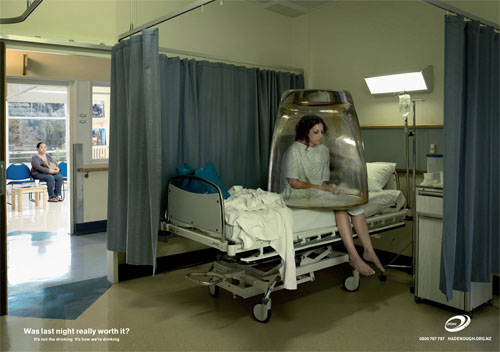
Figure 1


Figure 1
Company : ALAC -The Alcohol Advisory Council of New Zealand.
Campaign: Big Glasses
Media: CLEMENGER BBDO NZ
Site sourced: http://www.clemengerbbdo.co.nz/main.html
Date sourced: July 21st 2010

This group of advertisements are sending a very powerful message to the target audience: was last night really worth it? Are you happy with being useless/ lifeless the next day and the next, and the next?? These advertisements are controversial because they bring to life the after affects of alcohol abuse. Most advertisements outline what may happen to you, whilst under the influence of alcohol. These ads take that one step further, showing average individuals that have experienced binge drinking. I think the creative aspect of caging these individuals in their glass of peril is quite effective to get the point across. Also, I think it is very clever how the subjects are caged from their family members/ loved ones- using an emotional appeal.


Figure 2
Company : ALAC -The Alcohol Advisory Council of New Zealand.
Campaign: Big Glasses
Media: CLEMENGER BBDO NZ
Site sourced: http://www.clemengerbbdo.co.nz/main.html
Date sourced: July 21st 2010


Figure 3
Company : ALAC -The Alcohol Advisory Council of New Zealand.
Campaign: Big Glasses
Media: CLEMENGER BBDO NZ
Site sourced: http://www.clemengerbbdo.co.nz/main.html
Date sourced: July 21st 2010


In 2008 this advertising campaign received a Gold Effie for Social Marketing/Public Service for Clemenger BBDO.


See media article below.


ALAC ADS WIN ADVERTISING AWARD 
16 October 2008 
Peter Glensor
Alcohol Advisory Council of New Zealand
Sourced: http://www.alcohol.org.nz/MediaRelease.aspx?PostingID=35246


The Alcohol Advisory Council’s (ALAC) controversial binge drinking advertisements have won an award for effective advertising.

The advertisements won a Gold Effie for Social Marketing/Public Service for Clemenger BBDO at the awards ceremony in Auckland last week. The awards are run by the Communication Agencies Association of New Zealand (CAANZ) in conjunction with the Association of New Zealand Advertisers (ANZA) and Television New Zealand.

Comments from the judges included ‘short, sharp and meaningful'; ‘did a good job in a cluttered social marketing environment'; and 'the hard-hitting ads did a good job in a cluttered environment'.

ALAC Chair Peter Glensor said the advertisements attracted a large number of complaints due to their hard hitting content. However, he said, ALAC made no apologies for that.

“The ads show graphic examples of excessive drinking leading to harm, with three realistic characters eventually making poor and dangerous choices.

“These commercials are unpleasant but so are the consequences of binge drinking,” he said. “The ads mirror what is happening, unfortunately, every week around this country.

“It is time to be brutally honest about some of the worst effects of intoxication.”

Mr Glensor said that since the latest ads were released in April monitoring had shown 

  • Nearly all adults have seen, heard, or read something about our drinking habits
  • After prompting, 94 percent of adults recalled seeing at least one of the television advertisements
  • After prompting, nearly all adults are aware of the “It’s not the drinking, it’s how we’re drinking” message
  • Over half adult New Zealanders thinking about harm to themselves and others, resulting from their drinking
  • Over half adult New Zealanders identifying a wide range of harms resulting from their drinking (including relationship-type harms)
  • 38% have discussed it with others
  • 19% have thought about drinking less
  • 18% report they're drinking less than last year.
The ads had impacted on the number of first-time callers to the national Alcohol Drug Helpline, he said.

Of the total of 16,000 calls received at the Helpline in the past year, 12,000 (75%) were from first-time callers, statistics from the Alcohol Drug Association of New Zealand’s annual report show.

The total number of calls represents a 5% increase on the previous year’s calls, with the biggest rise in caller numbers occurring between April and June this year – immediately after ALAC new advertising campaign began.


www. pzrservices.typepad.com

www.nydailynews.com